Thursday, December 13, 2012

SPECIAL: Art Journal Entries for Art & Arch


The following includes a 9-entry compilation of art journal entries I've saved for my extra credit art journal for my Art & Arch class with Dr. Lisot. These entries include my in-depth thoughts and observation of the art and architecture I encountered while wandering about Rome, Greece, Northern Italy and many other places. Some may be repeats from past posts, but here's all the art-related material in one post. There are so many other places I could have written about, but these were among the greatest highlights. I'm really glad I was able to do this art journal. It made what I already wanted to do more of a "requirement." I wanted to write about all of my experiences with art and was so excited to have been able to have done this. The five extra credit points felt like a high-five for doing what I love. Thank you for the opportunity, Dr. Lisot!
________________________________________
 Entry #1: Capitoline Museum Class Visit
The Capitoline Museum was beyond anything I’d ever expected to see. For me, it embodied the perfect cross between Greek and Roman art as I think that the Greek aesthetic impacted the Romans’ artwork. Due to the great number of Roman sculptures that are copies of earlier Greek sculptures, it seems that the Romans appreciated Greek art and were inspired to carry on the tradition.

Every floor of the Capitoline Museum was like an artist’s playground. Every turn promised something spectacular. One of my favorite rooms was the Palazzo dei Conservatori where we had our Art & Architecture lecture. In that room was the famed bronze Equestrian Statue of Marcus Aurelius, dating back to 175 A.D. Back in the day, when people were destroying statues of the pagan emperors and dictators, it was not melted down because people thought it was a statue of Constantine, the respected emperor who had legalized Christianity. As it turned out, it was actually a statue of Marcus Aurelius. One big hint of this is that statues of Constantine usually depict him as a beardless man, but the man on this statue has a full beard. He was pretty fortunate to have escaped demolition. I had studied this statue previously in our Art & Arch I class back in Irving for freshman year, but to see it now was absolutely mind-blowing. Just looking at the statue made me marvel at how much detail can go into bronze.

Equestrian Statue of Marcus Aurelius

I thought similarly of the Etruscan bronze She-Wolf (500 B.C.) located just a few paces away. The patterns and textures of the fur, particularly around the neck, were among the most exquisite I’d ever seen in a bronze sculpture. I could even see the ribs underneath the skin of the She-Wolf. It was very admirable to see how much care the artist put into the sculpture, making a piece of bronze look so believable. Although the Romulus and Remus statues beneath the She-Wolf were made in the late fifteenth century by Pollaiolo, they fit into the piece very well. It’s pretty incredible how something so simple became the symbol of Rome.
She-Wolf
Another notable statue that I actually found to be pretty funny was the marble bust of Commodus as Hercules. I find it funny because Commodus, who was a real airhead of an emperor, is depicting himself as the mighty Hercules even though his character is nowhere near the level of nobility of Hercules. I guess it shows how a guy who knows that his reputation is shaky will do everything he can to paint an idealized image of himself. In Commodus’ case, he was trying to win over the people of Rome by depicting himself as Hercules. Try all you like, Commodus. The truth is always triumphant in the end, so making yourself out to be Hercules will not help you. Still, I will not deny the masterful craftsmanship that appears in this sculpture. I love the detail that shows up in Commodus’ hair and beard. Hair is something I would like to master in my drawing skills, so I think that looking at sculpture is a good way for a beginner to learn basic textures for drawing.

 
Commodus as Hercules


My absolute favorite part of the museum was the Palazzo Nuovo which was lined with nothing but marble statues. It was in one of these rooms that I finally met the Hellenistic Dying Gaul (230 B.C.) He was incredibly made, life size, and the pose was very convincing. I really admired how his weight was distributed and how his muscles suggested that he was summoning the last of his strength to take his final breaths. It seems that the artist intended the Gaul’s facial expression to provoke feelings of sympathy from the viewer as they watch him fade. And you know what, it worked. I could almost see the Gaul taking his final breath and prepare to collapse forward in a twisted position.
 
Dying Gaul
This and many of the other sculptures inspired me to learn and master the art of drawing the human figure. I can hardly wait to do so when I get back home!
________________________________________

 
Entry #2: Ara Pacis Class Visit
 
Ah yes, the famous Ara Pacis on the field of Mars. Augustus really had taste! This altar had some really amazing reliefs, some areas of which contained such small detail I would have missed it had Dr. Lisot not pointed it out, like the baby bird jumping out of the next to escape the snake. The three big panels on there included Aeneas’ sacrifice, the family line of Augustus, and my favorite panel, Tellus, the earth goddess with presumably Romulus and Remus seated on her lap with two nymphs flanking her and a cow and sheep at her feet. I think I’ve come to like organic-themed art since this one captured my interest so quickly. Here goes the formal analysis…
Tellus Panel

________________________________________

Entry #3: The Temples in Paestum


After our trip along the Amalfi coast, we made a visit to the Archeological site of Paestum where we visited Temple of Hera I and II. They look even bigger and better in real life than they did in the textbook. Both temples were very similar in that they had Doric columns, but Temple of Hera II actually had an entablature, metopes and friezes. It’s really amazing at how well-preserved these temples are. They have so much detail left in them. I could almost see the ancient Romans going in and out of the temples, worshiping the cult statues.


Following a few on-site lectures and lots of pictures, we were able to visit the Paestum Archaeological Museum and saw more ancient artifacts. It was really something.
________________________________________

Entry #4: The Cappuccin Bone Church


A couple of my friends and I went into Rome with no particular plan except to explore. Turns out as soon as we came out of the metro at the Palazzo Barberini, we arrived right in front of the Museum of the Cappuccin Monks and the Bone Crypt. On a whim, decided to go check it out. The museum featured paintings, artifacts and histories of the Cappuccin monks. The paintings in particular captured the poverty, piety and love of the Cappuccins. Many of them featured monks holding crucifixes, or gazing heavenward in contemplation, maybe with an open book (most likely the Bible) in hand. Everything was just breathtaking, and the stories of these monks, many of whom are saints, were just beautiful. My particular favorite was the famous St. Padre Pio.

The highlight of it all was the Crypt of Bones, which felt like a dimension all its own. The entire crypt was decorated with the bones of the deceased Cappuccin monks. As eerie, gross and creepy as it may sound initially, it was actually a very cosmic, peaceful experience. I was probably just as slack-jawed as I was in St. Peter’s (these Catholic places are really good at doing that to you). The crypt made me realize how dead to the world these monks were and how the life in this world is passing and has no comparison to the spiritual, eternal life that awaits us after death. The experience of seeing all those bones will serve as a reminder that we must be dead to the world, live in the world, and never be of the world and devote ourselves to the service of God, regardless of our personal vocation in the world.
Bone Crypt of the Cappuccin Monks
________________________________________


Entry #5: Best of Greece


Before leaving Italy, we made a visit to St. Nicholas’ relics (yes, THE Santa) located in a lovely church in Bari. Let’s stop to smell the flowers for a moment, literally! Phenomenon goes that if you go up to where St. Nicholas’ relics are kept and take a sniff, you’ll smell roses. No one knows exactly why. Sure enough, that’s exactly what we smelled. Pretty miraculous! Another really cool painting was in the crypt, which featured St. Nicholas smacking Airus during the council.


The next day, after arriving in Greece by boat, we visited Dodona, an archaeological site with a theater and several temples (or at least their remaining foundations), including a temple to Hercules and I believe there was one to Hera and to Venus. We stopped for lunch in Metsovo before moving on to Meteora, where visited an orthodox monastery. This monastery, along with at least for or five others, are nestled safely atop some unbelievable cliffs. You’ve never, and I mean NEVER, seen cliffs like these. It was so peaceful there and the sound of the wind in the cliffs was unlike any wind I’d ever heard. I think most of us left that place thinking, “I want to be a monk/nun.”


We spend the remainder of the following day (half of it was traveling) in the amazing city of Delphi. We explored the historical sites on Mount Parnassus, including the temple to Apollo where the Pythia herself would sit, inhale the vapors coming out of the ground (those weren’t there anymore), and give the oracle of the god Apollo. The size of the temples surprised me as I was not expecting them to be so huge. I think that Delphi’s archaeological site was the perfect compilation of all the types of architecture in the ancient Greek world.


The next morning visited the museum in Delphi where we saw lots of archaic and some classical sculpture and artwork. We left Delphi and moved on to Athens, but not before stopping at Hosios Loukas, an Eastern Orthodox Monastery. If there was one lesson we learned about the difference between the Eastern and Western parts of the Catholic Church on that trip, it was in 3 words by Fr. Thomas: East. West. Schism! It was great. It was incredible exploring the church with Byzantine-esque mosaics with golden tesserae. Within the iconography, we learned how the positioning of the fingers of Christ’s blessing hand represented his two divine natures (divine and man) and the trinity. The Eastern churches really have some of the most exquisite mosaics I’ve ever seen.

Later that same day we arrived in Athens, where we visited the Pnyx and the Areopagus, where I was able to participate in a student reenactment of a section of Aeschylus’ greek Tragedy, Eumenides (lines 674-807 if you’re interested). I played the part of Orestes. The view of Athens was stunning from our high-up location. The next day we explored the Agora temples, Hephaestus’ temple, where the Greek hero Theseus is supposedly buried. Our whole class successfully made a human chain around it. We continued on to the Agora Museum to check out all of the ancient pottery, which included a whole variety of red figure and black figure techniques as well as geometric techniques. Next came the Acropolis where we visited the oh-so-famous Parthenon, and the theater of Dionysus. I have to say it was pretty epic standing so close to such an amazing building, even if a lot of it was restored. Even to think for a moment that the olive tree of Athena was still preserved was just mind blowing. I think it was at this point in the Greece trip that I actually believed for a moment that the ancient gods and goddesses may have actually existed (although under the authority of God almighty).


The next day we visited the National Archaeological Museum in Athens, which featured some of the most incredible Greek artwork you’ve ever seen, including some familiar faces and places I’d studied back in Irving, like the Zeus/Poseidon bronze sculpture (who has really amazing arms that I want to integrate into a formal painting or drawing sometime in the future), and the Spring Fresco. This was the ancient artist’s playground! So many amazing pieces to look at. I swept through the entire museum in about 2 hours time, which is simply not enough time to enjoy everything. It was so sad whizzing through so many amazing rooms, but I did stop every once in awhile to stop and gaze at my favorite pieces. Ancient art never ceases to amaze me. After that trip, we moved on to Mycenae and visited the Lion’s Gate and Tomb of Clytemnestra. That, next to Delphi, was probably one of my most favorite archaeological sites of the visit. The view from the top of the site was, once again, jaw dropping. No wonder Agamemnon chose this site for his headquarters. The beehive-shaped tombs were pretty amazing as well. I was astonished at the acoustics in there, because as two of the students were beginning part of their re-enactment of Aristophanes’ The Frogs, it sounded as if we had a high quality sound system in there as their voices carried along the curves of the tomb. It was a great place to watch a play.

 
After staying in Napflion overnight, we visited the archeological site of Epidaurus a half hour drive away, the site of the Sanctuary of Asclepius the god of healing in the ancient Greek world and home to the extremely famous theater of Epidaurus. In this huge theater which seats…oh, I think it was something like 50,000 people, there is a disc in the center of the gravely stage on the ground and if you stand on that disc, tilt your head up and speak, the result is phenomenal. Your voice carries perfectly through the entire theater so that every seat can hear you and you can even hear your own voice bounce back at you, not like a super delayed echo, but like a slight microphone echo, but cooler! Why? Because you don’t need a microphone to sound cool in Epidaurus! I didn’t know what to say, so since it was still morning time I stuck with the morning greeting in Greek: “Kalimera!” That was about the coolest thing ever, hearing my voice jump right back to me. My reaction was pretty priceless too. I quickly and shyly walked away from the disc with my hand over my mouth and my eyes wide open, “Whoa! That was incredible,” was all I could say. The symmetry of the theater was gorgeous and it was in considerably good shape given its age. I’d love to go back and holler there again.


Before leaving Napflion the next day, we stopped to visit Alexander the Great’s Palamede Fortress overlooking the sea and Nafplion. It’s a great place for pictures and lots of cool steps and tunnels. We even found a cramped stone dungeon which we easily fit into, but it was horribly stuffy in there. It must have been absolutely miserable for the prisoners there. Outside on the ramparts, several times, I pictured Alexander the Great’s guards stationed in the various watch towers and posts along the edges of the fortress and wondered what their day would have been like, looking over the land and sea day after day.

When we arrived in Olympia that same day, we visited the Archaeological museum there for awhile and it was really great. It was incredible to see the curse on the house of Atrius come to life on what used to be in the pediments of these grand temples. It was especially interesting because that was what we had been studying for Lit. Trad. III. I’m really going to miss seeing all this amazing artwork in real life.

__________________________________________

 
Entry #6: Colosseum Class Visit


At last! I’ve come to one of the most historical icons of Rome: The Colosseum (a.k.a. Flavian Amphitheater), built by one of the Flavians, namely Vespasian, dating back to the 70-80 A.D. It wasn’t as big as I originally thought it would be, but it was, nevertheless, HUGE! As Dr. Lisot gave us our Art & Arch lecture on the history of the Colosseum, I scanned the expanse of the Colosseum, imagining hundreds of thousands of Roman citizens sitting in the bleachers, screaming and cheering at the tops of their lungs, thirsting for the sport of blood. It must have been an incredibly wild madhouse.

 
From where our class stood in the amphitheater, it seems that from the point of view of the raving audience, the gladiators and animals far below would have appeared to be the size of ants. It made me appreciate the huge TV screens that we have at concerts and basketball games so that we can see the performers up close. From the center of the amphitheater, however, a gladiator must have felt a rush of thrill upon stepping out to see the roaring crowds. This moment would determine either the glory of victory or the humiliation of defeat. I can only imagine the pressure that was added by the crowd’s roars while a gladiator was in combat. On the other hand, if there had been a Christian who was about to be martyred, he or she might humanly feel an initial surge of fear, but by the grace of God, they would be able to die willingly and peacefully, knowing that their witness to Christ would be an example to all the onlookers. It makes me wonder how many conversions to Christianity may have taken place in the Colosseum. Maybe the conversions had not been immediate, but God’s grace can always work in a person’s heart over time.

Looking at the Colosseum, I wonder what the acoustics must have been like during its prime. I was tempted to test out current acoustics with a holler, but I kept my peace. I took a closer look at the architecture, noting the triangular brick wedges used with the cement, which was a fairly new Roman invention, consisting of a mixture of sand, soil and water. The building pattern was unlike anything I’d ever seen used in architecture, but it was interesting. For it to have lasted so many years without falling apart is phenomenal.

Brick detail inside the Colosseum

The outside of the Colosseum was, of course, my favorite part. The care put into the building of this architectural wonder was evident. One thing I found particularly interesting about it (something I had discovered on my own) was that it had every type of column on it. At the bottom were the Doric order, second level were the Ionic order, third level were the Corinthian, and on the fourth level were the engaged Corinthian pilaster columns. It made me think of the evolution of the column over the years, with the Doric being on the simplest column, and the Corinthian being the highest, most sophisticated column. In a way, it corresponded to the advancement of the Roman Empire over the years.
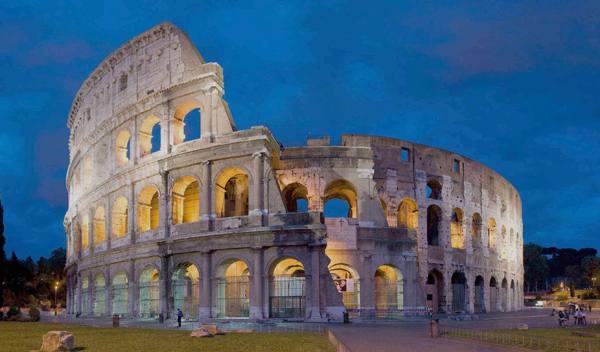
The Colosseum

Vespasian’s architectural feat remains as one of my all-time favorite monuments of the ancient world. It serves as a personal reminder for me to turn every piece of art I make into something memorable and beautiful. Thanks for the inspiration, Vespasian!
________________________________________


Entry #7: Vatican Museum Class Trip


Oh, where to begin with the Vatican Museum? So much to see, so little time. Actually, a surprising number of items we were studying in Art & Arch were kept at the Vatican Museum. Since there were so many and I have limited time to discuss them, I will mention just a few:

Laocoön
So, here is Michelangelo’s big inspiration/eureka for his artistic career. I’d have to agree with him on this one (but I still have a special love for his David). Laocoö n and his sons are definitely one of the best pieces of Classical sculpture that I’ve ever seen, especially in that twisting torso of Laocoö n himself. Really, his entire anatomy is brilliantly done as every muscle is contracting in response to the strain and the pain of the snake’s bite. Similarly are his sons as they helplessly struggle to free themselves from the coils of the snake as it wraps itself about their bodies. I like how the snake’s long body keeps the viewer’s eye moving about the sculpture, holding their interest. Even so, I have to feel sorry for Laocoö n and his sons, especially when their faces express so much pain and terror. Then again, they did mock the gods, so I guess they deserved it. Anyway, due to time constraints, I am unable to sketch the Laocoö n right now, but rest assured, I will do so the minute the fall semester is over. I will bring the memory of Rome back home with me by drawing every Classical sculpture I can find with Laocoö n at the top of the list. I can hardly wait!

 
Laocoön

School of Athens: Ah, now here’s a favorite! Every time I look at Raphael’s School of Athens (1509-11), I get all excited and inspired to learn and study. I mean, all of the coolest people in history are all together in this painting at the same time. If I could equate this to contemporary times, it would be something like Comic Con, where there is a mega-mashup of all of the character in all of the movies, books and videogames in existence. From a UD perspective though, this is even better! I like how busy the fresco is, with the hustling and bustling of all of these brilliant minds, all talking and debating with each other the way UD students usually do. There’s a perfect mix of teaching and learning going on throughout the image, which is why I find it so inspiring. An interesting thing I noted when observing this for the first time in real life at the Stanza della Segnatura was that there was a man leaning casually against the right wall (on Aristotle’s side), with one leg crossed over the other knee as he jots something down in his book. This was definitely an unexpected pose for a scene like this, but still, I like how studious the whole image feels.

School of Athens
Sistine Chapel
Last Judgment: I don’t know what Michelangelo was saying when he said that he wasn’t a painter. His paintings had my jaw on the floor. As requested by Dr. Lisot, when I first walked into the Sistine Chapel, I looked over my shoulder and up at the massive Last Judgment (1533-41) fresco that covered the wall where the altar was located. It was even bigger and grander than I had imagined. It captured the awesomeness of Our Lord and the chaos of the division between the souls worthy of heaven and the souls doomed for eternal fire in hell. The whole fresco made me feel very small and it was really overwhelming, but I think that Michelangelo intended for both to be the case as a reminder to the viewer of how small they are in comparison to the glory of God and of what everyone will have to face at the end of time.


Sistine Chapel Ceiling (1508-12): This was particularly brilliant! The figures looked so three-dimensional, they literally popped out of the ceiling. No photo or print could capture the true beauty and colors of the paintings. My favorite fresco was the Creation of Adam. It seems to illustrate the intimate relationship God has with all of his created ones. Actually, the depictions of the early Old Testament, especially the ones of the Creation and Adam and Eve, made me think about how amazing it is that we are made in the image of God and of how unfathomable His love is for us. He made the world for us, he made us who we are, and he made Michelangelo a master in painting. I love how all these things connect! After seeing the Sistine Chapel, I’ve found that my Catholic Faith makes me appreciate art more (especially pieces like this), and that art enhances my love for my Faith. The whole Sistine Chapel experience was not to be missed! It was a spectacular ending to a great afternoon at the Vatican Museum.


________________________________________

 
Entry #8: Accademia Class Visit in Florence, Italy

So I’ve always marveled at Michelangelo’s sculptures, even when I was a kid. To me, his work expresses artistic beauty in its rawest form and his sculpture David (1501-04) is the pinnacle of that beauty. I’d already been familiar with dozens of pictures of David, but when I first saw him in real life at the Accademia in Florence, Italy, I was blown away by how much more glorious he looked. He was everything I’d expected and more.

David was absolutely magnificent to behold. He had an idealized body with perfect proportions and anatomy. His skin, though marble, appeared smooth and soft to the touch. A shocking amount of detail had been employed into the sculpture. The muscles throughout his body could be seen through his flesh, all firm and tense as he prepared to face the invisible Goliath. Based on past sculptures and paintings by Michelangelo, it seems evident that Michelangelo’s favorite part of the body to carve was the torso. He has included a great deal of detail in David’s torso, ensuring that no muscle is overlooked. His arms and legs, though muscular, have beautiful curves. Even the bone joints in his elbows, knees, wrists, ankles, and fingers can be made out. His body is so tense with anticipation that his tendons are visible through his skin, especially in his neck and hands, which are incredibly large when compared with his face. I was most surprised to discover the pulsing veins in his large hands. That completely blew me away. The detail on David is unbelievable! I mean, I could literally see the energy building up, almost as if the statue were about to move.
 

David (Michelangelo)
I had never looked closely at David’s facial expression until this visit to the Accademia. Just as Michelangelo would employ “terribilita” (a face that expressed awesomeness and fierceness so as to almost strike fear into the viewer) into his God figure in the Sistine Chapel just a few years later, he used it here on David’s face. Even from my place far below, it was difficult to make out the fullness of the expression, but when I saw a more eye-leveled view on a postcard in the gift shop, I was amazed at how intense Michelangelo had made David’s face.
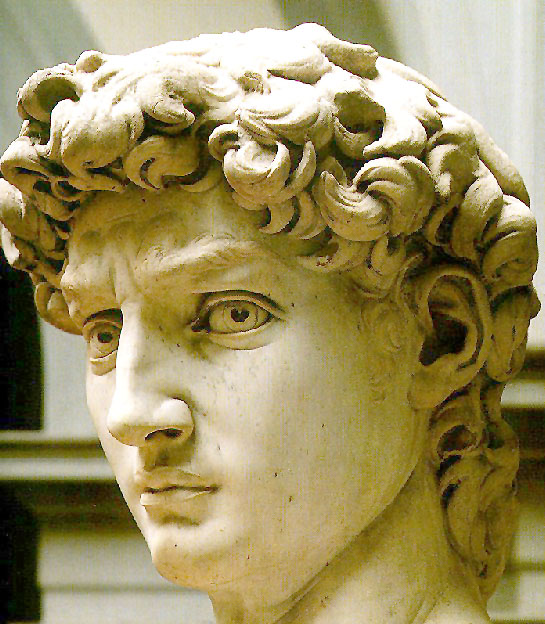
David (face detail)

I think of Michelangelo’s David as the pinnacle of perfection in the human figure (sorry, Laocoö n). It has been my ultimate inspiration for my desire to master the art of drawing the human figure. I am still awestruck at Michelangelo’s craft every time I see this sculpture. Furthermore, the piece revealed the splendor of the human body and how beautiful and sacred God created it. Michelangelo certainly understood this and frankly, I believe it too. Don’t let any other giggling student tell you otherwise because they obviously haven’t seen the piece through the lens of God and art. Still, to this day, it is a wondrous marvel at how one man could have sculpted something so perfect. I aspire ever higher…
________________________________________

 
Entry #9: Villa Borghese Class Trip
The Borghese trip was probably among my most anticipated class trips of the semester (nice way to end it too). Why? Bernini’s works are there! Since my section’s lecture was going last, I decided to explore the Borghese using the guide Dr. Lisot gave us. It’s a beautiful gallery lined with dozens upon dozens of paintings and sculptures. Naturally, the Caravaggio and Raphael paintings were my favorites. The highlights of the museum were the sculptures by Bernini.
I first saw Bernini’s life-size marble rendition of David (1623). Bernini’s technique was flawless. He had captured the moment when David was reeling back, twisting his body and pulling his slingshot taut in preparation to slay Goliath. David was well-proportioned and idealized to perfection. Every inch of his body revealed his tense muscles, which reminded me of Michelangelo’s David, only this time, a great deal of action was taking place. That’s what I like about Bernini’s sculptures: they all have a sense of motion so that you almost expect the figure to make their next move. In this piece, it literally looked like David was taking a sidestep forward and was having to pull against the opposing force of his slingshot. The line and texture used in his wavy hair added to that sense of forward motion. Speaking of textures, the armor that was placed behind David’s right leg contained beautiful textures as did his harp. David’s facial expression was just awesome! The faces I usually see in sculpture are plain and relaxed, filled with sorrow or pain, or else they are happy. I’ve run into very few angry or determined faces. This one definitely shines brightest in my book. Another likable thing about Bernini’s sculptures is that you have to walk around them to appreciate them in their entirety. I must have circled this piece at least three or four times, walking slower and slower each time to appreciate the beauty of this piece.

David (Bernini)

Heading into the next room, I ran into Bernini’s incredible Apollo and Daphne (1622). Just when I thought I’d seen the best that Baroque-style sculpture had to offer (I’d also seen his Ecstasy of St. Teresa at Santa Maria della Victoria), I was proven wrong. Apollo and Daphne took my breath away. Bernini brought the mythological scene of Daphne being turned into a tree and Apollo chasing her to life. He had captured the moment when Daphne is beginning to sprout leaves, roots and have tree bark envelop her body while Apollo pursues her from behind, swinging an arm around and catching her by the waist/belly. Again, I love the sense of motion incorporated into the sculpture. Both figures have a forward action while things like hair and cloth fly backward. There was a sense of twisting and ascending into the air, even though the piece was grounded. Bernini really captured the human form beautifully on both figures and gave a gorgeous contrast on how he depicts a young male and female form in one piece.


Apollo and Daphne
The amount of detail incorporated into this sculpture was not to be believed. The individual leaves and the billowing cloak on Apollo were all so thin, I could see the light shining right through them. Those particular sections of the piece looked so dainty and fragile that I expected to find areas where the leaves had been broken off. I found none. How could it be possible for such a piece to survive for so many years without suffering any loss? And even more extraordinary is the fact that the entire piece was constructed out of one piece of marble. ONE PIECE! How is that even possible with all of the detail? And Bernini was in his mid-twenties when he sculpted this! I’m sorry Michelangelo. You have some really phenomenal sculptures, but Bernini just raised the bar with this piece. This one is going down in history to be one of my all-time favorite sculptures.
Oh, but things just got better in the next room in which Dr. Lisot gave the lecture on Bernini’s Rape of Proserpine (Pluto and Persephone) (1621). What an incredible piece! The action…the drama…the realistic flesh…it was by far (alongside Apollo and Daphne) the most advanced sculpture I had ever encountered. Once again, sculpting from a single piece of marble, Bernini had caught the figures right in the middle of the action, with Pluto gleefully swiping a frightened Persephone off her feet as she pushes vainly against him to get away. Even Cerberus, the three-headed hound of the underworld was there, although he was much less menacing than Pluto. As in all of the previous Bernini pieces, the detail employed into the piece was masterfully done. I could make out every powerful muscle in Pluto’s body and the flailing hair of Persephone. Like Apollo and Daphne, there was a sense of twisting in the sculpture, with the turning of Pluto’s torso, the tossing back of Persephone’s head, her flailing arms, her hair, and even the flying fabric, which even made a kind of corkscrewed twist on the back view of the piece. This particular piece employed so much detail in emotional expression, particularly in Persephone’s face. I saw the open-mouthed expression of fear and despair consume her young face. Even a tear spilled from her eye. I found myself moved with pity for Persephone, who had never known such evil until now. It even made me angry at Pluto for destroying the innocent girl’s virginity.

Rape of Proserpine (Pluto and Persephone)

One particular spot that I just marveled at was the area where Pluto’s hands are grasping Persephone’s thigh and waist. The muscles in his hands are very convincing, but even more convincing is the way Bernini made his fingers appear to sink into the softness of Persephone’s skin. Even when I re-angled myself, Pluto’s fingers began to disappear into her thigh as it would if it were real flesh. I consider this a divine feat on Bernini’s part. And he was only twenty-three when he sculpted this? I’d imagine that he must have had the help of angels as the illuminators did with the Book of Kells. This seems too perfect to be the work of man’s hands. If there were Seven Wonders of the World in art, this sculpture would definitely claim a space in my book, as would Apollo and Daphne. I could go on an on, praising Bernini’s work…
 

Rape of Proserpine (detail)

As it was with Michelangelo’s David, Bernini’s work inspired me to reaching an even higher level of perfection in mastering the human figure. But to sculpt like Bernini, it seems unreachable. That doesn’t mean I can’t try. All things considered, Bernini just might be the greatest sculptor of all time!

Northern Italy Trip

5:30 a.m. wakeup call and in an hour and a half our entire UD class was rolling down the road bound for Assisi, the first of the three sites of our Northern Italy trip. We arrived at the charming little town shortly after lunch (I think we’ve all become thoroughly irked at the very idea of sack lunches let alone their taste). We split up into groups and visited the many amazing parts of the Basilica of San Francesco, which is really one church on top of another, not to mention the crypt where St. Francis himself is buried. I know I really came to like the paintings of Giotto, all of which covered the walls of the upper basilica. After our visit, we went to our hotel and checked in. From there, many of us joined Dr. Osborn on an excursion up the mountain rising behind Assisi to visit the hermitage where St. Francis would often go to retreat from the world and pray alone in total silence in a cave up there. Several of us, including Dr. Osborn and me, took off our shoes and socks to take the hike up there barefooted in honor of St. Francis. I only lasted maybe ten minutes mostly because the occasional uncomfortable rocks were making me walk considerably slower than the rest of the group. At least a couple of students made it the whole way there and back without shoes (quite admirable if you ask me). I don’t know how long Dr. Osborn lasted since he surged way ahead of everyone. I was among one of the last to arrive to the hermitage due to stopping along the way to take lots of pictures of the vast land below us and the fiery-leafed trees on the mountain. The walk was about an hour long.

I do recall that the moment I set foot on the property of the hermitage, all became incredibly quiet, as if I had stepped into another realm altogether. The loudest thing to be heard were the pebbles crunching under my feet and the occasional ever-so distant call of a bird. The hermitage was beautiful and exceedingly peaceful. We were even privileged to navigate through the narrow stone passages to visit the small cave where St. Francis prayed. Perfect silence reigned in that little cave and a very subtle holy presence could be felt. It was really amazing! On the other parts of the mountain right beside the hermitage were prayer spots and quiet trails. We even spied the tree that is said to have been the perch of many birds who would come to listen to St. Francis preach. The hour-long decent back to Assisi included a brilliant Italian sunset and the gradual increase of the many town lights far below. Upon our return to Assisi’s center, we went to Mass then were given an opportunity to shop for awhile before dinner. I decided to purchase a wooden Tao, which is the symbol that St. Frances devoutly used and wore. I later had it blessed by Fr. Thomas, our amazing UD alumni and Cistercian who has accompanied us on our big class trips since Greece.

Much to the students’ dismay after dinner, Assisi had no night life. Ever since I came to understand our Fall class to be party-prone and alcohol-happy (though usually not in excess), I figured that they wouldn’t last in a divinely quiet town like Assisi. And they didn’t. The town square just half a block down from where our hotel was located became the site of shrieks of excitement over Italian hot chocolate. For as quiet a place as Assisi is at night, you can practically hear a kicked pebble click on the street from a block away, so you can imagine how much racket they made. I honestly felt that unless we remained perfectly silent or kept out speech down to a whisper, our presence served as a corruption of the serenity of Assisi. Pretty quickly, I separated myself from the group and followed the students from afar as they made their way across the softly lit town to the Basilica of San Francesco. I felt very comfortable walking around alone at night. My only fear was getting lost, but I’ve learned that with my mental map-building (always forward from where I was last), I can easily retrace my steps. It worked! I easily made it to the basilica and, as it turned out, an American choir was performing in the church that evening, so some of us stayed for a short while. After listening to the performance, and taking a lot of night pictures outside, we headed back to the hotel in the peace and quiet.

Next morning some of us went to visit St. Claire’s church down the street from our hotel where we saw the crucifix that spoke to St. Francis. It was MUCH bigger than I originally thought, so that was a pleasant surprise. We then visited another church close by in which St. Francis’ prison is located. That prison cell is where his father kept him for a time. Only a few paces away, through the side doors of the church, is the Bernadone house. We were actually able to go into Francis’ father’s workshop and saw the original door to the house. After those brief adventures, we left Assisi and headed off for Florence.

Upon our arrival, we ate lunch with a panoramic view of Florence (a sight not to be forgotten). After checking into our hotel, we were given orientation tours around Florence by our professors and RAs. My favorite moment of the tour was turning a corner and having my breath literally taken away upon seeing the famous Florentine basilica and duomo. After the tour, which included a great deal of photo-taking, we had our class trip to the Uffizi art museum. Their collection is unbelievable! I could have spent weeks in there, but I only had a few hours. Even so, I used every bit of that time to admire the work of the masters. Botticelli and Caravaggio turned out to be my favorites. I will mention, though, that I came across a large painting of the Slaying of the Innocents which was so saddening, disturbing even, that it actually made me cry when I thought about the real war on women (abortion and contraception) and the culture of death that rages through our society. I’d never been so affected by a painting before, and I’ve most definitely never been driven to tears (well, maybe a little while working on my own art projects in the studio.) After the Uffizi, we went to the Piazza Reppublica (one of the main piazzas in Florence) and explored the various booths that were set up, selling meat, chocolate, spices, cheese, oil, and pastries. You could almost have an entire meal with all the sampling that’s available there. Dinner, a led walk back to the hotel by an RA, and hit the hay.

Day two in Florence was even better! The morning consisted of group tours to various places around the city. My group went with Peter Blute, one of the RAs, to visit the Pitti Palace, one of the largest museums in Europe! Once again, I could have spent forever in there, but we had so many places to see! The very next thing we did was what we’d all wanted to do: climb the duomo to see the whole of Florence. The climb was considerably shorter than the climb up St. Peter’s Basilica dome, but it was rough nonetheless. The view was worth it though. After taking dozens of pictures up there, were climbed down for lunch, which was to be on our own.


As I’d done in Greece, I survived on whatever I’d managed to save from breakfast in the hotel and on whatever food samples I could scavenge at the markets of Piazza Reppublica (yes, Mom, I got my protein in. I promise). From there I followed the leather-shopping students. The leather market has the best smells in the world! There was no way I could afford anything leather, no matter how authentic it was or how badly I wanted it, but the smell was worth every moment. After enjoying the day of wandering around Florence, even running into Dr. Hatlie and his family during the day, we met up with the rest of our classmates at the Accademia, where we had a class on Michelangelo and his masterpiece, David.

I was completely awestruck at Michelangelo’s craft. David was absolutely magnificent to behold. A shocking amount of detail had been employed into the sculpture. What surprised me most were pulsing veins in David’s large hands. You could literally see the energy building up, almost as if the statue were about to move. For me, this sculpture is the pinnacle of perfection in the human figure. It has been my ultimate inspiration for my desire to master the art of drawing the human figure. Furthermore, the piece revealed the splendor of the human body and how beautiful and sacred God created it. Michelangelo certainly understood this and frankly, I believe it too. Don’t let any other giggling student tell you otherwise because they obviously haven’t seen the piece through the lens of God and art (not even the majority of the art students, unfortunately). That latter reason is why I don’t like going on these class trips to see nude art, because of all the crass jokes and giggles that come up. It’s so childish and immature. In this particular excursion, I’ve learned two lessons about class trips like these: 1) ignore the silly children who don’t recognize or appreciate the sanctity of the human person, and 2) to avoid those kids, stick close by the professor giving the lecture since the fewest giggles and jokes are said in front of her. The rest of the evening was pretty much a repeat of the night before, except that after dinner, some of us went on an evening excursion to the Piazza Michelangelo for a panoramic night view of Florence. It was brilliant! Gelato followed, courtesy of UD. Afterwards we slowly dispersed, either to find a bar or go shopping or go to bed. I followed a group of hotel-bound UDers from a distance (I would have preferred to be alone that evening), but because I kept taking so many pictures on the walk back, I ended up separated from them and as fast as I walked, I never caught up with them, nor did I even see them. Even though the RAs had told us to not go alone in the city, I unfortunately had to. It was alright though since I knew my way back to the hotel, long and twisty as the road may have been (I’m really liking my mental maps!) Also, Florence has a less “hostile” feeling than Rome, and I’ve been through Rome several times alone, even at night (most definitely not my favorite thing). In the end, I somehow beat the group I’d been following to the hotel as they didn’t show up for another 10-15 minutes. Who knows how that happened!


The sky was crying hard the following morning. I don’t blame it, because I was going to miss Florence, but I wasn’t nearly as sad as the sky, whose tears drenched us and followed our bus all the way from Florence to Venice. It stopped raining there, thank goodness. The minute we arrived I knew I was going to like Venice, what with all the boats as the means of transportation. We rode a private vapporetto boat from our busses to our hotel, having a laughingly good time feeding the multiplying seagulls who followed our boat (video to come!) The scene literally reminded us of the seagull chase on Finding Nemo. Makes me wonder if the Pixar crew tried what we did…*Oh!* Sorry for daydreaming. Anyway, once we were settled at the hotel, which pleasantly turned out to be a religious guest house with religious statuary and crucifixes everywhere, we went on our orientation tours around Venice. I have never in my life seen streets as confusing as the ones in Venice. It’s extremely easy to get lost. I was at least glad that I could retrace my steps whenever I became lost (that’s for tomorrow though). All of the students had unlimited passes for the public transportation system, which included large vapporetto boats that worked like busses, stopping every 200-400 meters along the Grand Canal and the edges of the island. I was on cloud nine every time I set foot on these boats, and I rode them often, so I definitely made the pass worth every penny. Orientation ended, and some of us went exploring for awhile before Mass. Now the day before we’d arrived in Venice, they’d been experiencing some terrible flooding, and even that morning, the water level had been up, so the entire floor of the church was drenched. Pretty amazing if you ask me. After Mass was dinner, then we headed back to the hotel for bed, opting to take the vapporettos which offer even more exciting views at night, what with the lights on the water and all.


I awoke to the sound of a wailing siren outside, roughly at around 6 a.m. I knew what that sound meant. I was up and out of bed and at the window in a blink. The siren meant that the waters were going to rise that day and that Venice was going to be flooded. They give you a three hour warning with that siren, so when you hear it, you have that much amount of time to either board yourself indoors or suit up for an adventure on the watery streets of Venice. Literally, they were swimming in St. Mark's square the day before. Anyway...

Our second day in Venice was not unlike our second day in Florence. It started with a group tour somewhere, then it was free time for the rest of the day until dinner. My group was led by Dr. Nelson, our philosophy instructor, who toured us through the naval museum which featured model after model of the entire history of boats, missiles and warheads. As one of the guys pointed out before our group set off, I was the only girl in the entire group. “Hey, that’s fine. I like boats!” was my response, although I will admit it did feel slightly awkward. Still, it was kind of nice to deal with boats and explosive stuff for a change. Learning about the history of some of these incredible boats and the battles they went through were jaw-dropping. At the top floor of the museum, arguably the best room there, were all of the old boss missiles. Ironically, the room right beside it (the one which Dr. Nelson told us before we entered that it was the best room in the museum) was filled with cases of sea shells. I’m not kidding. But these shells were actually jewels to behold. You’ve never seen such exotic shells of such strange shape, color and size.


Wrapping up the museum trip, I decided to head off and explore Venice on my own. I explored St. Mark’s square, which was half flooded from earlier, and visited the Church of St. Mark’s (I missed seeing his relics). I then hopped on a vapporetto and traveled counterclockwise around Venice, stopping at whatever stop looked interesting. I debated about visiting Murano, which is known for its glass blowing, as I was unsure of the amount of time I would have to explore all of Venice by vapporetto. I eventually decided to take that trip to the island where I explored the many shops, watched some glass blowing, and eventually purchased a small glass orchid, blue in color (not a bad deal for 8 euros). I also made sure to visit the Byzantine-styled church of Santa Maria and San Donato Cathedral where there are some real dragon bones (see larger picture below). The story goes that a dragon was going about the town, spitting venom into the wells and poisoning the water. St. Donato came along and found the dragon and when he spat on it, the dragon turned to ash, leaving behind only a few bones. The bones included a couple of ribs and what might be a leg bone. Maybe dragons did exist…


After exploring Murano, I stopped by Cemetary Island which is on the way back to the Venetian mainland. The island is literally a giant cemetery with different areas reserved for Catholics, Protestants, Jews, Muslims, etc. It was huge, and there wasn’t even remotely enough time for me to explore the whole island without missing out on exploring the rest of Venice. After maybe half an hour, I took the vapporettos back to Venice and explored the rest of its outskirts until I reached the train station, then headed back down the Grand Canal to the Rialto Bridge to visit the shops around there. Venice is really beautiful at night. When you follow the main roads with bright lights, it’s fairly easy to find your way around. I eventually met up with my class for dinner. Even though they announced that they were extending curfew hours to 1 am, I opted to go to bed earlier than later, though not before sailing one last time on the vapporettos to a deep southern island of Venice I had not yet visited. I stayed only on the water though. The night was foggy, but it made for a very cool experience in the cold of the night.
 

I found out the next morning that there were lots of problems with heavy drinking that last night in Venice, even sending one student to the emergency room. That caused the faculty and staff to decide to ban public drinking on campus for the students as a safety precaution. It didn’t bother me in the least since I’m not a big alcohol consumer, but it seemed like a grueling punishment for nearly all of the other students. *shakes head* Silly children students. I think they deserved it though, if you ask me. Alcohol had become so objectified at this point. Why can’t people learn to have fun without alcohol and just appreciate the city for what it is?

The bus ride home was incredibly long. Our tailbones were screaming by the end of the trip, but the adventure had been worth it. Back to studying…

Monday, November 19, 2012

A Tribute to the RAs

Just today, I was having an inexplicable desire to be up there in the ranks with the RAs. I really love the Rome RAs and laud them as my heroes. In some ways, I think they personify the Catholic Church insomuch as they set reasonable rules for the students to follow and they have to endure scorn behind their backs (trust me, I’ve seen and heard it coming from whining students many times both in Irving and in Rome). Through all the ups and downs of their job, the RAs always -- ALWAYS -- manage pull through with exemplary selflessness and patience.

My parents were (and still are) my constant role models back at home, but when I came to UD the RAs took up that critically important role. There is not a day that goes by that I do not find myself admiring the RAs for all the hard work they do. I can only imagine the many long hours of hard work and countless sacrifices they make without the students’ knowledge, all in order to make campus life better for the students who may never realize how much they need their RAs.

I pity the student who expresses animosity and bitterness at the very mention of an RA who has dutifully performed their task in upholding the campus rules. Even worse, I feel badly when the students make fun of the RAs who are enforcing reasonable rules and safety measures, much to the disdain of the sometimes rebellious student. It is for those reasons that I praise the RAs as my heroes. I don’t just want to be like them; I want to BE them! I really can’t sing their praises enough!

Even though most of the RAs are technically only 2 or 3 years older than me, they feel like the older brothers and sisters I never had, all of whom I can go to for advice, wisdom, and good company. They have contributed to some of my fondest memories and experiences of my Rome semester. By their example they have helped me become a better, more mature person over the course of the semester, and for that, I must thank them from the bottom of my heart.

It is with teary eyes and a nostalgic smile that I close this small tribute to the Rome RAs. I am sincerely going to miss each one of them, all of who have wordlessly inspired me to apply to become an RA in Irving. I will never forget my RA heroes of Rome.

Thank you Ryan, Ellen, Tony, Peter and Sara for all that you have done to make the UD Rome semester the greatest experience of my life!

With warmest regards,
Kathleen R.

P. S. All of the above applies to all RAs everywhere. Thanks for being an example to us all!

Thursday, November 15, 2012

Retreat! Run for Your Lives! Wait, Let Me Pass Out For a Second. Okay, Let's Go!

10-day ends and what happens? We get slaughtered by homework, papers and tests. Day in and day out, it’s nothing but constant studying, not to mention the pressure of the presidential election which is adding to the anxiety. The Tuesday after we returned from 10-day, our Theology paper was due, and the following Monday was going to include an Art History quiz, Tuesday would bring a Western Civilization test, Wednesday would be the Philosophy exam and Thursday we would leave for our Northern Italy trip. Stressed out yet? *cue Beethoven’s 5th* Dun dun dun duuuun. DUN DUN DUN DUUUNNNNNN! Well the Theology paper wasn’t too bad. At least that weekend I would go on the women’s silent retreat UD was offering.

The retreat was fantastic. It was located at a beautiful retreat house located on the side of a mountain with a perfect view overlooking Lake Albano and the entire city of Rome further out. It literally felt like being outside of the world for a couple of days. Everyone had their own room too. The food and accommodations were fabulous and we had 24 hour adoration/exposition. I always learn something new on retreat. This time I learned about the Ignatian way of Meditative and Contemplative prayer. After all that I’ve read about these methods of prayer, I am really hyped about trying them out. One of my favorite parts of the retreat included saying the Rosary with Fr. Benedict Groeschel and Simonetta (ipod) and the Chaplet of Divine Mercy in song (also ipod) while overlooking the nighttime view of Rome and Lake Albano. It was so beautiful. By the end of the retreat, I think I was the only one who immediately missed the silence the moment everyone was allowed to speak again. I really value and enjoy the silence and solitude, so it’s always hard at the end of a retreat, even if my friends whom I haven’t seen in ages are on that same retreat. Yeah, I think I’ll always stand alone on that one.

I didn’t study during retreat, so the tests the following days were killers. Actually I’ll take that back. Monday’s Art & Arch quiz was pretty easy, but Tuesday’s West. Civ. test was very intense. It’s the short amount of time we have to complete the test that causes the most pressure on the students. Considering the short amount of time, I think I did alright on the first half of the test, but I’m still pretty shaky about the second half. Whatever grade I receive on this test, I’m determined to seize and destroy the final test without question or hesitation.

Wednesday rolled around and I didn’t want to be told the presidential election results until after the Philosophy exam so as not to add to my mental distractions. That didn’t work out so well as the election results slipped out in the form of shaking heads and soft dismayed whispers amongst the disappointed students and instructor. And that was literally just seconds before the professor handed us the exam. No! Wait! That didn’t just happen! Our religious freedoms…marriage…the sanctity of life…all cast into the furnace to be turned to ash? I tried to proceed with the exam for the given hour and a half of writing, but I found myself stopping every other sentence, even though I knew the material almost to the letter, finding myself filled with the fear of what dark future might lie ahead for the American people. Civil war? Riots? Terrorist attacks? Religious criminals? The rise of complete governmental power and the total persecution and annihilation of all morality and religion? It was as if I was suddenly trapped in a nightmare that showed no promise of me ever waking up. Almost halfway through my responses to the question (I was doing alright on time), I came across a stumbling block. Aristotle’s three causes of the soul. Oh, why couldn’t I remember the second one? Aagh! Brain was racing. I was already mentally spent from all the heavy-duty studying we’d been doing the past few days and I was on overload. I’d slept enough the night before (I promise I was in bed shortly after midnight), but I hadn’t eaten breakfast (I’d survived plenty of UD exams and tests without eating prior). I was hot though I’d taken off my jacket, I was on a time limit, I was stressed about the election results and the future of America, and I didn’t know how to answer the next part of the exam question, and I couldn’t continue writing the essay without answering this part first. Too much pressure! Lightheadedness…shallow breathing…I’m not going to beat the faint this time. This wasn’t the first time I’d faint during a test (recall the ACT fainting incident, complete with concussion), but at least this time I knew what to expect. To avoid speaking to my classmates during a test, I put my head on my desk and positioned myself in such a way that I would ensure my safety of not falling out of my chair like I had at the ACT. I let my arm hang off the edge of the desk and clutched my pencil, knowing that the moment I passed out it would fall from my hand and my classmates would know something was wrong. I did feel the pencil slip just a second or two before I passed out. The last thing I remember thinking was, “I’ve always wanted to pass out upon hearing bad news…”

[…and then I saw the Forms…] (philosophy students will get that one)

…light…sight…head still on the desk…then upon realizing I was coming out of a faint, made a mental arm pump, “Yes! Did it!” Fainted upon hearing bad news: check! More or less. At least I disappeared from the nightmare for a few seconds. Gosh, I love telling these fainting stories. Meanwhile, pretty much every student within a two seat radius from me bolted forward to revive me. My next thought: “No! Go back to writing your exams. Save yourselves!” Oh, here’s another good part. This was the first time I’d ever had some water splashed onto my face as a means of reviving me. I’d always wondered if that worked. Let me tell you, it definitely helps! It actually makes the fainting experience more epic because as you wipe the water from your face you feel like you’ve gone through an ocean of timelessness and have come out refreshed. I was still pretty shaken from the trauma of, well, everything. The RAs came to help me as I urged the students who had helped me to hurry back to their exams. The poor professor, who had apparently never had this happen to him, made sure I was okay before the RAs took me out of the room and said I could finish my test later after I returned from our class trip to the Vatican Museum that afternoon. I recovered in the student lounge over a few snacks for a quick blood sugar boost, all the while praying for the other students who were still testing, hoping that my incident hadn’t slowed them down much.

I wasn’t myself for the rest of the day. I don’t think many of us were anyway. The news of the presidency left a rain cloud hanging over the majority of the students and faculty for the rest of the day. Listening to Mozart’s Lacrimosa with another student seemed appropriate while a couple of students chanted “Obama 2012! Four more years!” at the back of our bus on our way to the Vatican Museums. They received little to no recognition by the rest of the students on board. I wasn’t sure why I teared up. Maybe it was because I already felt the persecutions against conservatives already beginning…maybe because I knew of the terrible danger looming over the heads of the American people, particularly the Catholics and all people who valued morality…maybe out of compassion for the people, particularly Catholics, who lauded Obama and did not understand how hostile he was toward Christian values…whatever the reason, I was happy to be heading toward the heart of the Bride of Christ on such a dark day.

The Vatican Museum and Sistine Chapel were unbelievable. So much art in such little time! Gorgeous sculptures, detailed paintings, intricate tapestries, and ancient pottery. I only wish I could have been able to appreciate it more if I had not been so out of it after my faint. Usually after I faint, I’m really lethargic for the rest of the day and I’m just not myself. In all honesty, I don’t think very many students were able to enjoy it as much as they could have due to the heavy beating they’d had on the hard studying for the past few days. Nevertheless, the experience was very memorable. I mean, Michelangelo’s Sistine Chapel characters pop right out of the ceiling. They look so real!

I returned to campus after our Vatican Museum visit and was able to pick up where I’d left off on the test. I was better prepared this time and was able to finish almost five minutes before my time was up. I thanked God! All that was left for me to do was pack up for our Northern Italy trip, and our wakeup call was going to be at 5:30 a.m!

10 Day: There and Back Again

I know it’s been ages since Part I of the 10-day adventure blog post, but at long last, here is part 2.

Day 5 - Tuesday 23rd

I woke up thoroughly refreshed after several rough days. After a short breakfast, I attended the Monastic Office which was like the Liturgy of the Hours, all in French of course, but it was spoken, chanted and sung by the nuns, complete with a kind of large lap harp. The Monastic Office was just heavenly and lasted a good 45 minutes or so. After that we went off on our adventure through Paris.

Astonishingly, we crossed paths with some of our fellow UD Romers on the metro. It was a very pleasant surprise. From there, we visited Notre Dame, which was magnificent to behold. I had wanted to visit Chartres Cathedral (my favorite gothic church in the world) about an hour’s train ride away, but it wouldn’t have worked out. But Notre Dame is definitely a close second in my book for a gothic church, what with its lavish detail and breathtaking rose windows. From there we’d intended to visit the Louvre art museum, but as it turned out, it was closed on Tuesdays. I know, another heartbreaker. Nothing is going to be perfect. We did shortly explore a little of the gardens next to the Louvre, which were quite charming.
More walking and we saw the famed Opera House (cue Phantom of the Opera overture), and then we saw three incorruptible saints within the same hour -- St. Vincent de Paul, and then St. Catherine Laboure who was at the one address I memorized since childhood: 140 Rue de Bac, Paris. To our surprise, the third incorruptible saint was there: St. Louise de Marillac, the co-founder of St. Catherine’s order, the Daughters of Charity. From there, we visited the Eiffel Tower once again, this time staying long enough until it sparkled at dusk. It was quite impressive and incredibly exciting! After a satisfying day of travel, we ate a quick dinner at McDonald’s (they have a euro menu too) and returned to the guest house. We were all very tired from all the walking around, but the excitement of living a hallway away from a grand church was enough to keep me wide awake to attend 10pm Mass and stay for a silent rosary in the near-darkness as I had the night before. Some things are worth repeating. If only it could have lasted all night…
 
 
Day 6 - Wednesday 24th

Next morning was a repeat of the previous morning with early breakfast and the Monastic Office. We checked out of the guest house, eternally grateful for having stayed at such a glorious place, and headed off for the train station for a half-day of traveling. Despite a couple of delayed trains, our guardian angels made sure to get us to Kaiserslaughtern, Germany on time to be picked up by some good friends of mine who are stationed in Germany. The family-friends of ours were extremely kind and generous to us. They made us feel right at home, even with their three little children running around, and fed us our first real dinner in a long while, complete with an exceedingly delicious sparkling white sweet wine from Trier, Germany, the place we were to visit the following day. Oh, and we even tried some German and Czech chocolates, which were fabulous. It was really great to be sleeping in a cozy home.

Day 7 - Thursday 25th

It’s pretty rainy in Germany, or at least it is in Ottenbach. The hour-long morning drive to Trier, Germany was pretty misty as well, but that was more in the mountains. Once we arrived in Trier, we explored three of the churches at a leisurely pace. They were lavishly decorated and were mostly if not completely gothic in architecture. Not even a photograph could capture the majesty of the church.


By the time we were done, it was lunchtime. Prices for food in small German towns are surprisingly cheap. I mean, who buys a deliciously large hot pretzel for 49 cents? Or a satisfying fish and chips meal for three euro? (okay, more like 2,99 without tax) Great food! After that, we wandered throughout Trier, finally coming across the house of Karl Marx. Yes, THE Karl Marx, the father of communism. His house, which includes a courtyard and a garden in the back, is a museum now which you can explore and read about his life. Pretty intense stuff! I found the politics and history a bit difficult to chew, but it was nonetheless interesting.


Afterwards, we visited Constantine’s basilica, that is the basilica in the architectural sense, not the church sense. Constantine’s basilica is now a protestant church, but still retains is ancient aura. The Aula Palatina building next to it was very beautiful on the outside (we didn’t go in), and the gardens in front of it were bright green. We ended our expedition on the other side of the gardens in the charming park with a long duck pond and vibrantly colored fall leaves, enjoying the scenery from a park bench. Our host came to pick us up, but not before taking us out to eat at a restaurant with delicious German food. We arrived home tired but very pleased with the events of the day.


Day 8 - Friday 26th

Next morning we all visited the American base which was pretty neat, particularly when we went shopping. It was like being in the United States for a few minutes. After going back home and sitting down to a nice warm lunch on a chilly day, we took the hour-long drive to Heidelberg, Germany. We first visited the castle on the side of the mountain overlooking the charming red-roofed town and the snaking river and bridge below. On the other side of the river was another mountain covered with fiery multi-colored trees. It was probably one of my most singularly favorite sights in my European adventures. It definitely appears in my top 10 favorite sights (be sure to look for a top 10 countdown blog post of my favorite sights at the end of the semester).

Anyhow, we explored the castle, the apothecary museum inside, and saw the biggest beer keg in the world! Ending the castle visit, we drove down into the town and visited the bridge, did a little shopping (all window shopping for me as usual), ate dinner at Pizza Hut, which turned out to taste a dozen times better than the American version, and returned home for our last night in Germany.

Day 9 - Saturday 27th

2 a.m. wakeup call. Or, more like 2:30 a.m. because my guardian angel was slacking on its duties of waking me up. *ahem!* Our hosts did the work of being our guardian angels and woke us up for the hour-long drive to Frankfurt airport. During the night drive, it started to snow! It didn’t stop even when we arrived at the airport. Unfortunately, it was not the kind of snow that sticks to the ground, but it was still pretty exciting, more so when I watched the snowflakes collecting on my window on the airplane and melting away as we ascended for the 2 - 2 ½ hour long flight to Rome. Once in Rome, we made our way into the city and ate at The Scholar’s Lounge, an Irish pub, for lunch. We stuck around for a few hours, trying to sort out where we would stay for the night. Eventually, we decided to bite the bullet and stay at a hostel down the street from the Termini train station. It ended up costing us nearly 40 euro each, though we had been led to thinking we were staying for 20 euro each, and two of us were going to be staying in a mixed dorm, but thank the merciful Lord that the two people who were already occupying it were women, though they were the slightly eerie, tattoo-covered college party girls. They weren’t there when we walked into our room and they arrived much later that night, making minimal noise and spending most of their time on their iphones when they weren’t sleeping. I was so exhausted and wiped out from the frustration of getting directions, running around with heavy luggage, and having to pay what felt like an arm and a leg for my hostel that I just crashed and went right to sleep the minute we checked into the hostel and found our room. Oh, and it was only 3 p.m. when I went to sleep. I slept soundly and didn’t wake up until one of my traveling buddies woke me at a quarter to 9 p.m. to tell me that there was a free pasta party downstairs which was ending in fifteen minutes. I was planning on skipping dinner since I’d paid so much for the hostel and I had been sleeping most of the day anyway, so I could have lasted until morning, but it looked like God was taking care of us. The pasta party was at the small restaurant right next door to the hostel, and the only stipulation was that you buy a drink and get free pasta. We each purchased a 2 euro water (really, you’d think that water was scarce at prices like that!) and received generous helpings of pasta pomodoro (tomato). I went right back to bed after that, feeling just a little better. Daylight savings time began that night, so we turned the clock back and looked forward to savoring an extra hour of sleep. Still, I remember the last words I mouthed that night to my guardian angel right before drifting off to sleep: “Okay. I have a Papal Mass to attend tomorrow morning and I really don’t want to miss it. I’m sure you don’t want to miss it either, right? So I REALLY need you to wake me up on time this time. No slacking off now, okay? Alright. Thanks a bunch. Goodnight!”

Day 10 - Sunday 28th

Woke up shortly before my traveling buddy’s phone alarm went off at 5 a.m. “Thanks a ton, Guardian Angel!” We were up and rolling in no time. We checked out of the hostel and headed right to Termini, down to the baggage holding area. We had to wait until 6 a.m. for them to open, but we had our luggage checked in for holding while we attended the Papal Mass. We arrived at St. Peter’s Square a good half-hour before the scheduled time to meet with the priest to collect our tickets to get into the Mass. We found him right on schedule, collected our tickets and made it safely into St. Peter’s Basilica. Following Father’s advice as he’d handed us our ticket, I grabbed the seat closest to the main aisle where the Pope himself would pass through. As I sat reciting what must have been the 50th rosary for me within those 10 days, I found myself relieved to be reunited with my fellow UDers, safe and at home in the heart of the Catholic Church after a long, hard 10-day. Well, at least half of the trip was stressful and hard. The Papal Mass marked the closing of the 50th anniversary of the Second Vatican Council. It was even broadcasted on EWTN! Pretty exciting! The best part was being there watching the hundreds of priests and bishops pass me and proceed up the aisle to the main altar. And yes, I saw Pope Benedict. He was at least five to eight feet away from me! He blessed me and my companions too! The Mass was a perfect ending to 10-day. At my urging, immediately after Mass, we headed right back home to campus, arriving a good hour and a half after the Mass had ended. And yes, as I’d said I would after the half-traumatic 10-day, I did kiss the campus ground upon our arrival, almost laughing hysterically.

10-day was a pretty intense adventure. I really learned a lot about myself on this trip. Some of my flaws were confirmed on this trip, such as my impatience and the reluctance of taking on the role of leadership. I even discovered faults that I didn’t even realize I had, such as anxiety, doubt, and mistrust. All the same, I was spiritually strengthened by the experience. I know I prayed the Rosary a great deal more than I have in awhile, I talked a LOT more with my Guardian Angel (though I’ve already had pretty good communication with it), and I learned that trust in God is essential for survival. Speaking of survival, I found this to be one of my greatest strengths on the trip. I’m already a very thrifty person, but my frugality was taken to a new level on this trip as I was careful, almost to an extreme at times, when making financial decisions for myself and my group. I also survived on whatever food was available, even if it wasn’t very filling. Don’t worry, I made sure I received enough nutrients in the end. I turned out to be pretty good with navigation, even though I doubted myself for awhile. I found I have a good sense of the general layout of a city or at least the general direction of where things are, and I’m actually better at navigating smaller areas and small towns than huge cities (for one of my traveling buddies, it was the other way around). I actually chart a mental map in my head as I go, so in some ways I don’t really need a map. That skill has come in handy time and time again. I was also the interpreter/language-link for my group. I was amazed at how much my group valued my bilingualism, even if the Spanish is not as refined as I’d like it to be. I found the Spanish to be pretty useless for a good 75-80% of the trip (they don’t speak much Spanish in France and they speak lots of English in Germany). Even so, knowing a Romantic language made understanding French just a little easier, and it has also made understanding Italian a whole lot easier.

I also discovered that I actually have better street smarts than I initially thought I’d had. I could always tell when and how to keep a low profile, whom to avoid, how to blend in with the crowd and become nearly invisible (an uncanny talent I’ve already possessed), and knew how to evade every last street vendor, gypsy and pickpocket without being ripped off. On several unfortunate occasions, specifically in Paris, France, my fellow traveling buddies fell prey to street “vendors” who usually forced them into paying outrageous sums for the most ridiculous “souvenirs,” if they can even be called that. For me, fortunately, I adopted the “rude” attitude and practiced it unceasingly, wearing an assertive, firm and (at times) almost angry expression when passing by a potential money-snatching vendors. My singular moment of glory on that aspect was actually in Rome after the Papal Mass when we had to purchase some metro tickets from the kiosk and a lady came along as the tickets were printing and she tried swiping as they printed. I literally smacked her hand out of the way and exclaimed “NO!” Yep, I even surprised myself at how easily I did that. She spoke all Italian, but I understood that she was trying to get us to give her the tickets because she “needed them.” “How much are you asking for them?” she asked in Italian, but I wouldn’t hear of or acknowledge a word of it. When she remotely attempted to swipe our change as it came out of the kiosk, I pushed my aggressive attitude, completely blocking her from the deposit slot. I was so aggravated that I forgot any Italian and talked back in Spanish. She didn’t leave us alone until I’d collected our tickets and change and stormed off, my buddies trailing close behind. Yeah, I think I’ve got these people figured out…for the most part. Even the most seasoned traveler has been pick-pocketed at least once. I’ll do everything I can to avoid that.

With all that I’ve learned about myself on 10-day, in a way I feel I’m a different person. As the saying goes: “Know thyself.” I still have a long way to go with that. Let the journey continue!